
Alternative to chip timing: what to choose for your race?
In brief
- More than 1,000 runners or finishes to the hundredth: the chip remains the right choice.
- From 100 to 1,000 bibs: the QR code does the same job for a fraction of the price.
- Fewer than 100 runners and zero budget: paper still does.
Chip timing is the reference for big events: an RFID tag in the bib, a mat at the finish line, and results to the hundredth of a second. But for a club race of a few hundred runners, the invoice and the logistics quickly weigh. Here are three ways to time your race, with the strengths and limits of each, including ours.
Which system for my race?
Chip timing: the choice of big races
It is the system every runner knows: a tag stuck to the bib or fixed to the shoe, detected by a mat or an antenna on the line. The equipment is rented and set up by a specialised provider.
- Strengths: precision to the hundredth of a second, the ability to handle a big flow of finishers without a volunteer at the line, and indisputable results in a tight sprint.
- Weaknesses: a classic provider usually charges €2 to €5 per bib, equipment and crew included. You must book in advance, plan the equipment logistics and build this cost into the entry fee.
- For whom: races of more than 1,000 participants, sprint finishes, races where course records are certified.
The QR code alternative: volunteers flash with their phone
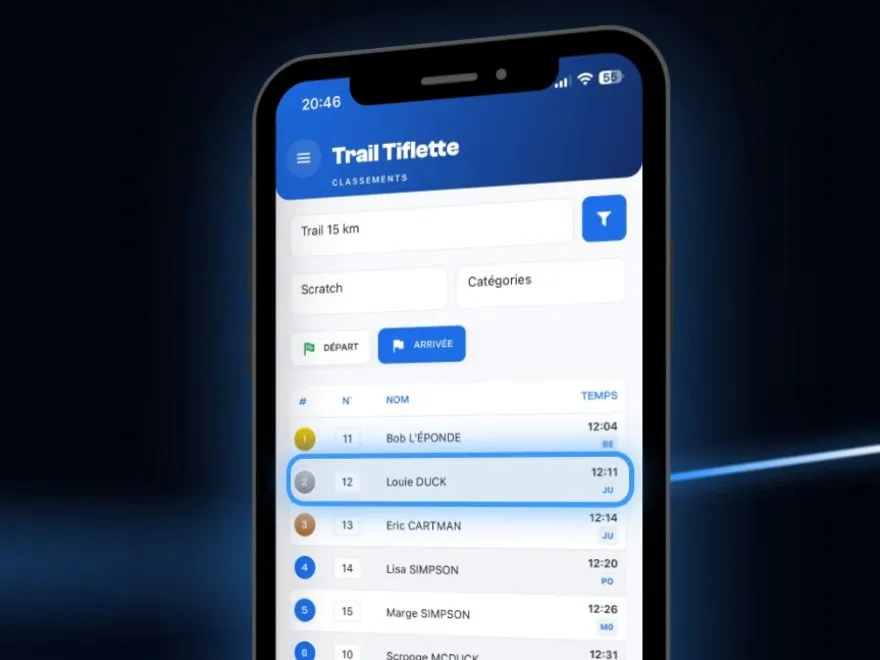
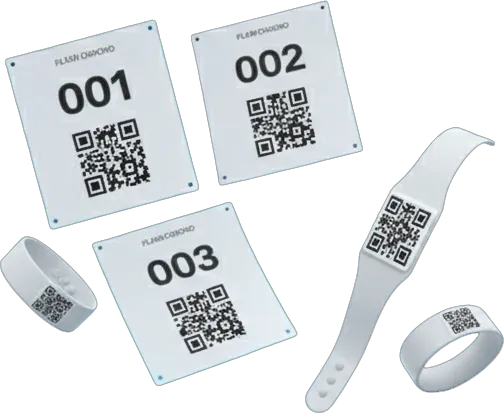
That is the Flash Chrono principle: each bib carries a large QR code, and your volunteers flash it with their own smartphone as runners cross the line. Rankings update live for runners and families, with no equipment to rent.
- Cost: app credits cost €0.42 to €1.18 per bib depending on the pack (from Pack 50 at €59 up to Pack 2000 at €849). The Discovery offer is free (20 credits, one event per month) and QR codes are generated as PDF for free: you can run full tests without spending anything.
- Equipment: your volunteers’ phones, that is all. For rough terrain (trail, mud, rain), reusable FLASH wristbands replace the paper bib.
- Acknowledged limits: precision depends on the volunteer’s reflex. It is not hundredths of a second, and two runners crossing within the same second are separated by the flash order. You need at least one or two volunteers at the finish. And the system is designed for races under 1,000 participants: beyond that, a timing mat remains more comfortable.
The manual option: stopwatch and spreadsheet
For a small race (a school run, a village cross-country with fewer than 100 runners), a volunteer with a stopwatch and a paper sheet can be enough: you note finishing times, retype them later, sort.
- Cost: zero euros, apart from the retyping time.
- Limits: it hits a ceiling very quickly. Paper recording creates errors, retyping takes the evening, and there are no live results for families. From a few hundred runners, the exercise becomes risky.
The comparison at a glance
| Chip provider | Flash Chrono (QR) | Manual | |
|---|---|---|---|
| Cost per bib | €2 to €5 | €0.42 to €1.18 | €0 |
| Equipment | Rented mat and tags | Volunteers’ phones | Stopwatch, paper |
| Volunteers at the finish | None | 1 to 2 | 2 to 3 |
| Live results | Yes | Yes | No |
| Recommended size | Over 1,000 | Up to 1,000 | Under 100 |
So, what to choose?
More than 1,000 runners or finishes to the hundredth: chip timing remains the right choice, and nobody will blame you. A club race of 100 to 1,000 bibs with motivated volunteers: the QR code alternative does the same job for a fraction of the price, with live rankings as a bonus. Under 100 runners and zero budget: paper still does.
Next, read our 5 organiser tips for race day.
To try it in the field, the Discovery pack is free (20 credits, one event per month). Estimate your budget per bib with the pricing calculator.
Read next
 BudgetHow much does timing a club race cost? The full comparisonRFID provider, manual timing or QR codes: the real costs for a 400-runner race, choosing your bibs, and 3 tips to build your budget.Read the article →
 GuideTiming a race with phones: the guideQR code bibs, how many volunteers, where to stand at the finish, race-day checklist: how to time a race with smartphones, and its limits.Read the article →
 Tips5 organiser tips and tricks for race dayWalking check-in, cable ties, muddy bibs, a QR code for the crowd, call room: 5 field-tested tips for a calm race day.Read the article →