
Timing a race with phones: the guide
In brief
- Each bib carries a QR code; a volunteer flashes it at the finish with a smartphone.
- Up to 300 runners, two volunteers are enough: one flashes, the other checks the finishing order. For 600 to 1,000 runners, two phones side by side, one lane each.
- Ideal from 100 to 1,000 bibs; no hundredths of a second, but live results.
For a long time, timing a race meant renting a mat, tags and a crew. Today a smartphone is enough: each bib carries a QR code, your volunteers flash it as runners cross the line, and the rankings appear live. Here is how to organise phone-based timing, step by step, with its limits, openly stated.
The principle in one sentence
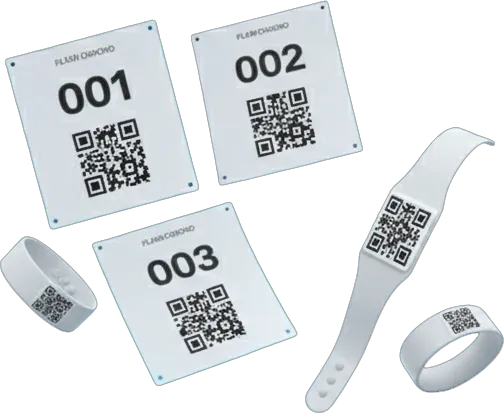
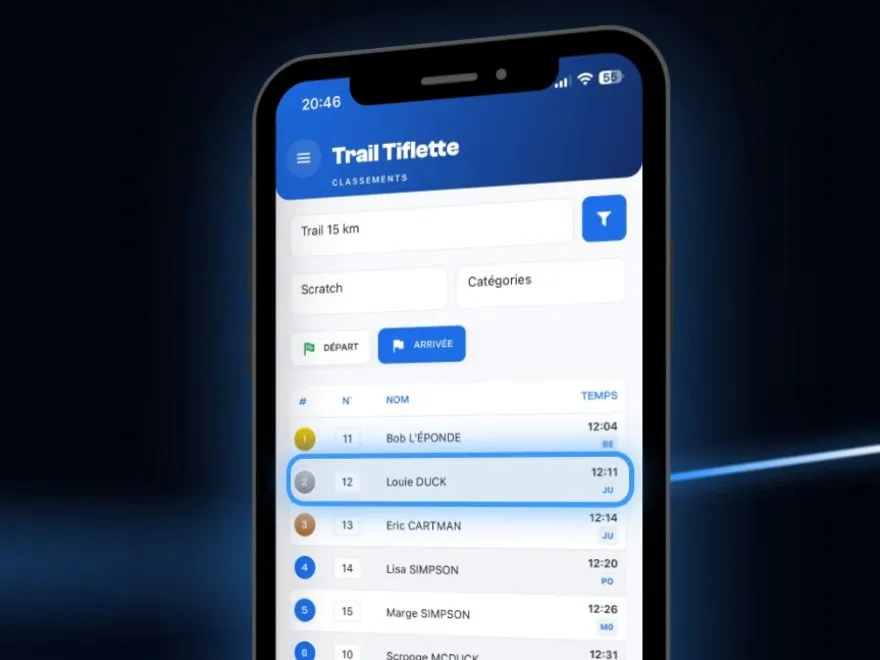
Each participant wears a bib printed with a large QR code (or a reusable wristband for trail running); at the finish, a volunteer opens the Flash Chrono app on their phone and flashes each runner in finishing order. Time, rank and the live ranking are computed automatically, and spectators follow the race from their own screen.
Before race day: three preparations
- Generate your bibs. QR codes are generated as PDF, for free, ready to print at any local printer.
- Import your entry list. Your Excel or CSV file loads into the app: names, clubs, categories. No retyping.
- Run a full-scale test. The Discovery pack is free (20 credits, one event per month): flash a dozen test bibs with the volunteer team a week before, so everyone has the reflex.
How many volunteers, and where to put them?
- A classic finish (up to ~300 runners): one flasher on the side of the line, and if possible a second one checking the finishing order by eye. Two volunteers are enough.
- High throughput (600 to 1,000 runners): two phones side by side, one lane each, or a relay flasher to avoid saturation.
- The briefers: tell runners to keep their bib clearly visible on the front (not under a jacket, not on the back of a bag).
- A double flash breaks nothing: if two volunteers flash the same runner, the best time counts. Handy when you are starting out.
Race day: the flasher’s checklist
0 / 4 ready
What the phone does not do (and the chip does)
Let’s be clear: this is not timing to the hundredth of a second. Precision depends on the volunteer’s reflex, and two runners crossing within the same second are separated by the flash order. For a championship, a course record to certify or more than 1,000 participants, a timing mat from a provider remains the right choice.
For a club race, a school cross-country or a village trail of 100 to 1,000 bibs, the phone does the job, and brings the live results that paper cannot. To compare both approaches in detail, read our chip, QR code and manual comparison.
How much does it cost?
App credits cost from €0.42 to €1.18 per bib depending on the pack (Pack 50 at €59 up to Pack 2000 at €849), and the Discovery pack is free to try (20 credits, one event per month). The hardware is your volunteers’ phones; for muddy trails, reusable FLASH wristbands replace the paper bib. For details, see how much race timing costs.
To try it in the field, the Discovery pack is free (20 credits, one event per month): your volunteers flash QR bibs with their own phone, and the rankings update live.
Read next
 BudgetHow much does timing a club race cost? The full comparisonRFID provider, manual timing or QR codes: the real costs for a 400-runner race, choosing your bibs, and 3 tips to build your budget.Read the article →
 ComparisonAlternative to chip timing: what to choose for your race?RFID chip, QR code or stopwatch: cost per bib, equipment, volunteers and limits of each method for timing a club race.Read the article →
 Tips5 organiser tips and tricks for race dayWalking check-in, cable ties, muddy bibs, a QR code for the crowd, call room: 5 field-tested tips for a calm race day.Read the article →