
How much does timing a club race cost? The full comparison
In brief
- RFID provider: between €1,200 and €2,000 incl. VAT for a 400-runner race.
- Manual timing: €0 investment, but errors and results that take ages.
- QR codes with Flash Chrono: €329 (Pack 500) for 400 runners, i.e. €0.66 per runner.
For organisers of road races, club trails or village runs, timing is often a real budget headache. Between quotes from external providers running to several thousand euros and the paper-and-pen improvisation that makes volunteers tremble, what is the fair price for timing an event?
Here is a transparent analysis of the real costs of each method, with concrete figures to help you settle your budget with peace of mind.
The classic RFID timing provider: comfort at a high price
Hiring a professional timekeeper equipped with detection arches and RFID chips (stuck to the bib or the ankle) is the historical solution of large events.
What does it really cost a club?
- Travel and technical crew: €350 to €600 per event.
- Unit cost per chip / bib: €1.80 to €3.50 incl. VAT per participant.
- Optional extras (big screens, results by SMS, intermediate points): €200 to €500 more.
Typical invoice for a 400-runner race: between €1,200 and €2,000 incl. VAT.
The reality: for a 3,000-runner race with many financial partners, this cost is easily absorbed. For a friendly 100-to-800-runner trail with a €10 or €15 entry fee, however, the provider swallows between 25% and 40% of all entry income.
Manual timing (paper / stopwatch): free on paper, costly in energy
Many small clubs, for lack of budget, go for the home-made method: volunteers with stopwatches and notepads at the finish line, followed by retyping everything into Excel.
The financial cost: €0 of direct investment (apart from buying bibs).
The hidden cost in the field
- Intense stress for volunteers when runners finish in tight groups.
- High risk of typing errors or swapped bib numbers.
- Endless waiting for runners: rankings often come out 45 minutes to an hour after the last finisher, delaying podiums and teardown.
Mobile QR code timing (Flash Chrono): autonomy at a fair price
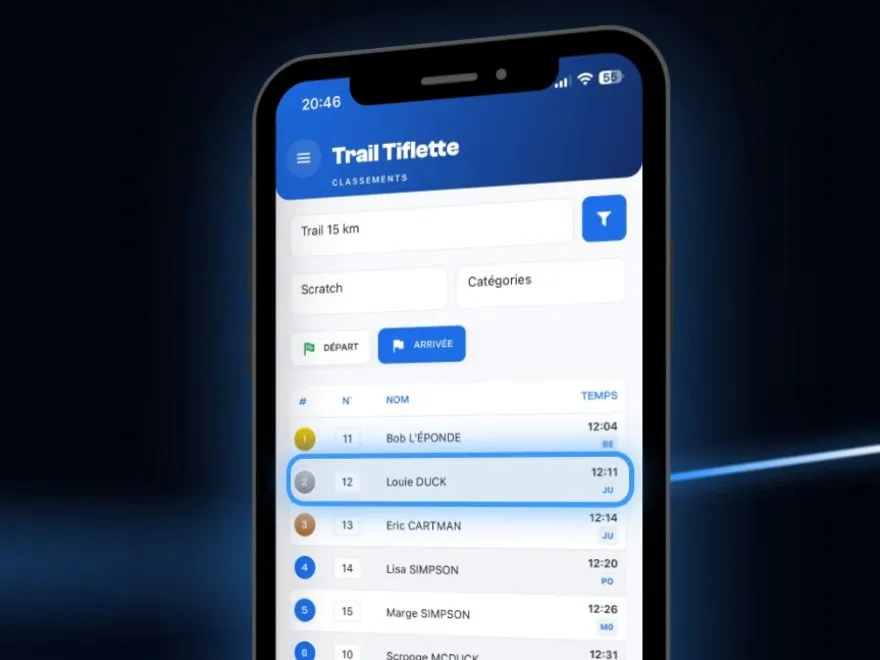
To bridge the gap between RFID chips that cost too much and paper that risks too much, the Flash Chrono mobile solution lets volunteers flash bibs with their own smartphone.
How does the pricing model work?
- No timing hardware to buy or rent: your volunteers use their phones.
- No monthly subscription: you only pay for what you use.
- 1 credit = 1 bib assigned. Credits are valid 12 to 24 months depending on the pack, and can be used across one or several races.
The price grid (incl. VAT)
| Pack | Credits | Price incl. VAT | Per bib |
|---|---|---|---|
| Discovery | 20 credits | Free | — |
| Pack 50 | 50 credits | €59 | €1.18 |
| Pack 250 | 250 credits | €199 | €0.80 |
| Pack 500 | 500 credits | €329 | €0.66 |
| Pack 1000 | 1,000 credits | €499 | €0.50 |
Typical invoice for a 400-runner race: with Pack 500 (500 credits for €329), timing costs €0.66 per runner, and the remaining credits stay valid for next year’s edition.
The saving: you divide your timing budget by 4 to 5 compared with a classic provider, while keeping instant live rankings in the cloud.
Simulate your race
Estimate based on the article’s ranges (crew €350 to €600, €1.80 to €3.50 per chip), excluding options and bibs.
Disposable bibs or reusable wristbands: choosing your supplies
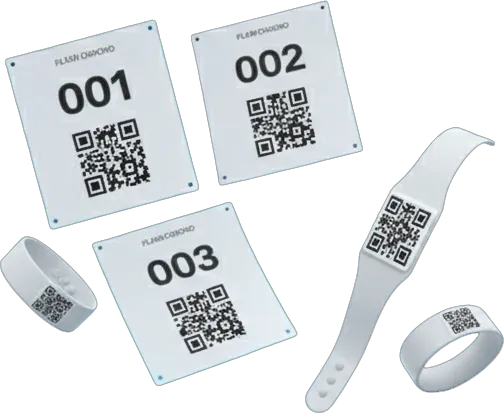
Besides the app, the organiser must provide a physical support carrying the QR code. You have three options.
Option A: standard bibs (Tyvek)
Tear-proof bibs, numbered in large print with a very readable QR code, pins included.
- Price: on quote, depending on quantity.
- Single use: ideal for road races where participants like to keep their bib as a souvenir.
Option B: FLASH wristbands (reusable PVC)
Flat PVC tags fixed to the wrist with a band. 100% waterproof, crease-proof in the mud and ultra-resistant.
- Price: on quote, depending on quantity.
- Reusable: you collect them at the finish (with the cable-tie method) and reuse them next year. The cost of the support drops to €0 from the 2nd edition.
Option C: fully autonomous printing (free)
Generate your QR code sheets as PDF for free from the Flash Chrono app and print them on your own supports or labels.
Three tips to build your timing budget
- Look at the “cost per finisher”: timing should never exceed €1 to €1.50 per runner for a friendly club race.
- Avoid fixed costs you cannot amortise: do not rent heavy technical equipment that requires a paid technician if your volunteers can do the job simply.
- Run a risk-free full-scale test: use the free Discovery offer (20 credits) and print your first QR codes as PDF to validate the experience with your team before committing your budget.
Want to cost your next edition precisely? Estimate your budget with the pricing calculator, and try the app for free with the Discovery offer.
Read next
 GuideTiming a race with phones: the guideQR code bibs, how many volunteers, where to stand at the finish, race-day checklist: how to time a race with smartphones, and its limits.Read the article →
 ComparisonAlternative to chip timing: what to choose for your race?RFID chip, QR code or stopwatch: cost per bib, equipment, volunteers and limits of each method for timing a club race.Read the article →
 Tips5 organiser tips and tricks for race dayWalking check-in, cable ties, muddy bibs, a QR code for the crowd, call room: 5 field-tested tips for a calm race day.Read the article →